
Introduction to Data Acquisition
Data acquisition (DAQ) is the process of collecting and measuring electrical or physical signals such as voltage, temperature, pressure, and more, converting them into digital data for analysis and storage. This process plays a vital role in engineering, scientific research, industrial automation, and product testing. In today’s fast-paced technological world, having reliable data acquisition systems is critical for making informed decisions, improving performance, and ensuring safety.
Why Data Acquisition Matters?
Data acquisition systems help organizations:
- Monitor and improve operational performance
- Predict equipment failures and reduce downtime
- Collect research and testing data for development
- Ensure compliance with safety and quality standards
Whether it’s environmental monitoring, product testing, or machinery diagnostics, accurate and efficient data logging is a must.
Key Components of a Data Acquisition System
A typical data acquisition setup includes:
- Sensors: To detect and convert physical phenomena (temperature, pressure, etc.) into electrical signals.
- Signal Conditioning: Prepares signals for conversion (e.g., amplifying, filtering).
- Analog-to-Digital Converter (ADC): Converts analog signals into digital data.
- Data Logger or Acquisition Device: Stores and processes the collected data.
- Software Interface: Allows visualization, analysis, and export of data.
Graphtec GL260: Compact Power for Field & Lab Use
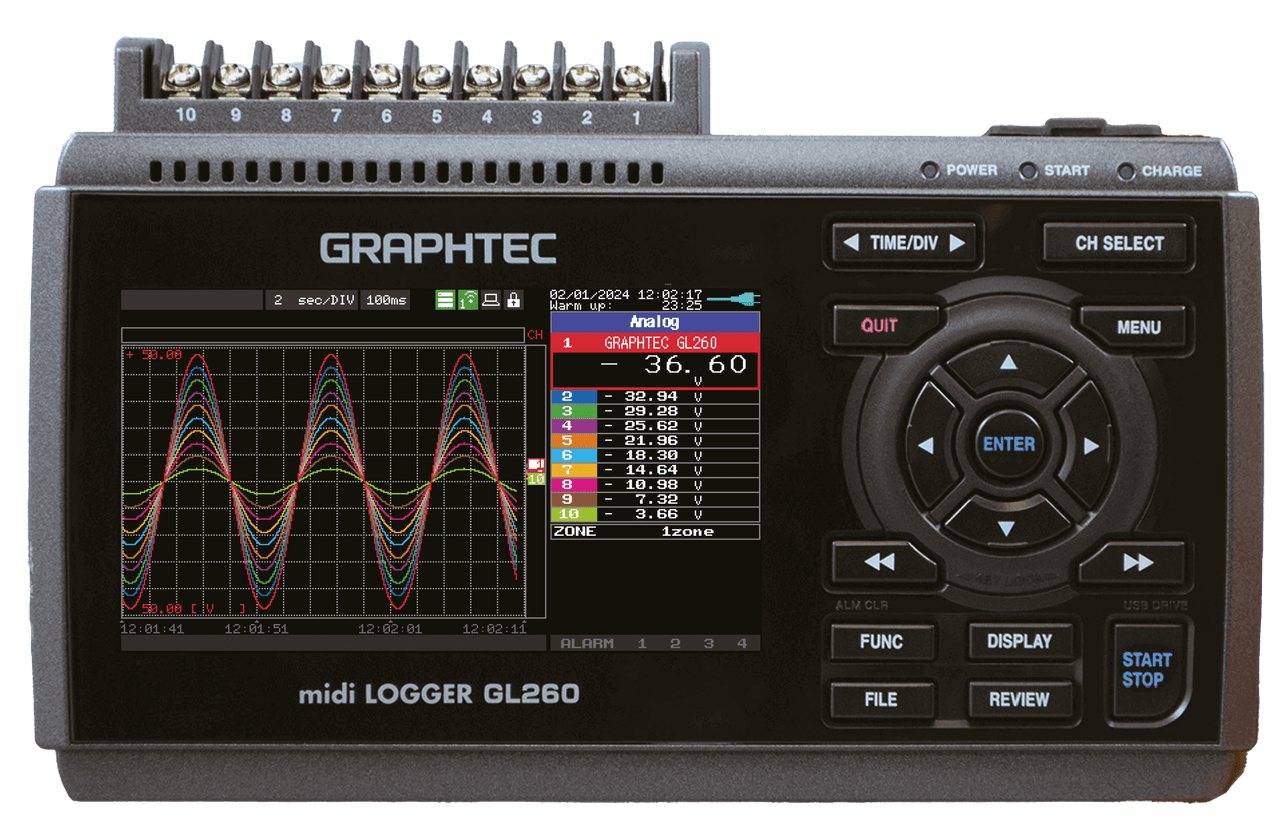
The Graphtec GL260 is a compact, 6-channel data logger designed for high-speed, high-accuracy data acquisition in both laboratory and field environments. Ideal for environmental monitoring, electrical testing, and multi-sensor input tasks, the GL260 supports:
- Thermocouples, RTDs, and voltage inputs
- Sampling rates up to 10 ms
- Built-in memory with USB storage support
- PC software for real-time display and analysis
Thanks to its portable design and ease of use, the Graphtec GL260 is a go-to solution for technicians and researchers who need reliable, on-the-go data collection.
Graphtec GL860: High-Channel Count for Complex Applications
For more demanding applications, the Graphtec GL860 offers advanced performance with up to 100 analog channels (via expansion), making it perfect for:
- Industrial automation
- Large-scale environmental monitoring
- Power systems analysis
- Long-term testing in R&D labs
Key features include:
- Wide input signal support (voltage, temperature, logic, pulse)
- Sampling speed up to 10 ms across all channels
- Internal memory with SD card/USB support
- LAN and USB connectivity for remote access
With its large channel capacity and robust feature set, the GL860 is a powerful solution for high-volume data acquisition needs.
GL260 vs. GL860: Which Data Logger is Right for You?
| Feature | Graphtec GL260 | Graphtec GL860 |
| Channels | 6 Analog Inputs | Up to 100 Channels |
| Portability | High (Compact & Lightweight) | Medium (Desktop-Class) |
| Sampling Speed | Up to 10 ms | Up to 10 ms |
| Signal Types | Voltage, Temp, RTD, Thermocouple | Voltage, Temp, Pulse, Logic |
| Ideal For | Field Testing, Lab Use | Industrial & Complex Systems |
Applications of Data Acquisition Systems
Data acquisition is used across various industries, including:
- Automotive Testing
- Environmental Science
- Aerospace & Defense
- Power & Energy
- Manufacturing & Automation
- Biomedical Research
Whether you’re analyzing climate data or testing engine components, devices like the Graphtec GL260 and Graphtec GL860 provide the accuracy, reliability, and flexibility required to get the job done.
Conclusion: Invest in Reliable Data Acquisition
Modern industries rely heavily on data acquisition systems to make data-driven decisions, improve safety, and optimize performance. Tools like the Graphtec GL260 and GL860 provide scalable and versatile solutions, tailored to both simple fieldwork and complex multi-channel environments.